
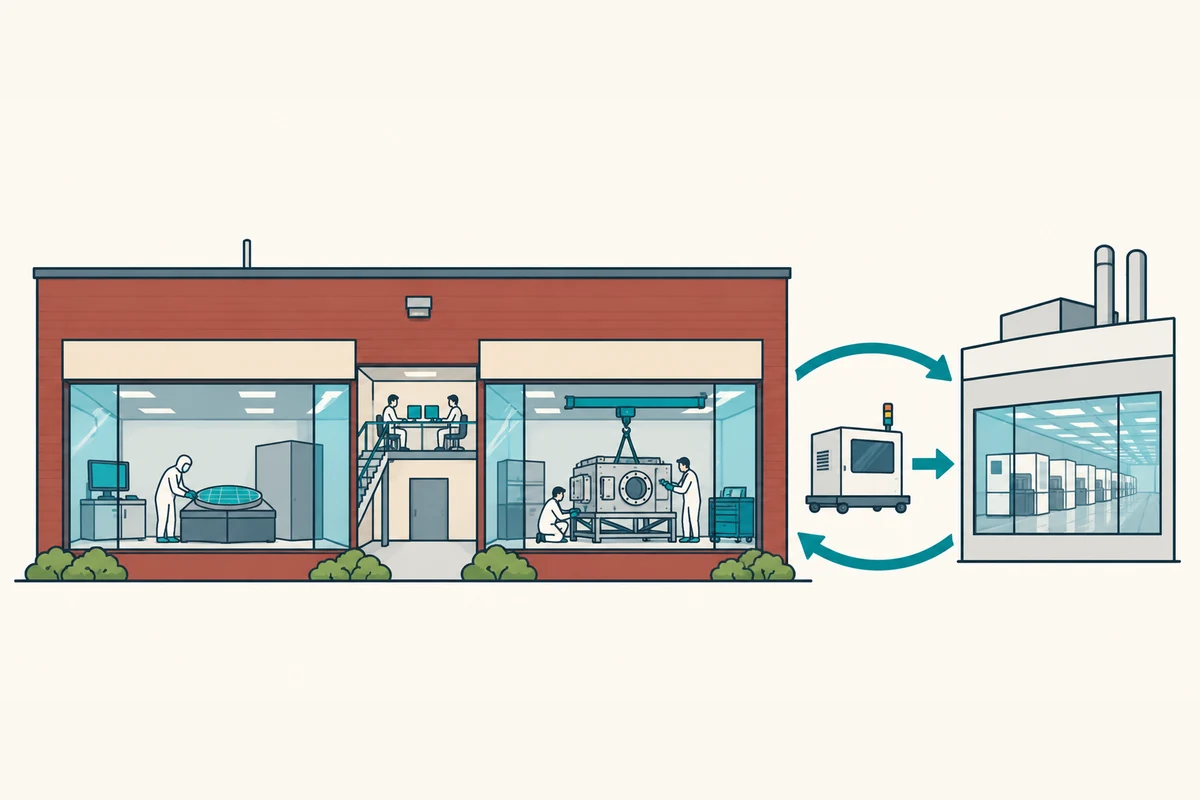
ACM Research opened a research and equipment manufacturing facility in Hillsboro, Oregon, on November 17. The company says the space covers 40,000 square feet, including 24,000 for production and a demonstration lab in the building. It calls the opening a milestone in the first phase of a plan to invest more than $100 million in its United States operations. The facility gives North American customers a nearby place to evaluate wet-cleaning and electrochemical plating tools. A buyer can bring an equipment problem closer to the people who build the machine. The value of that proximity depends on what happens after the demonstration. ACM Research’s opening announcement · KOIN’s report on the opening
A chip manufacturer buying a processing tool has to establish more than its ability to operate. It needs to see how the tool handles the fab’s materials, how repeatable the results are and what support is available when performance changes. An equipment supplier can demonstrate a process in a controlled lab and then adapt the machine to a buyer’s line. Combining researchers, production staff and field support at Hillsboro could speed up those exchanges. Evidence of accepted tools and repeat service would show where it helps.
The development is an equipment factory and engineering lab. Its output is machinery that customers can install in wafer and packaging plants. That distinction sets the relevant unit of progress. Equipment assembly and repair can move closer to customers, while the number of working chips depends on the work done in customers’ own facilities. The first useful questions concern how long a tool takes to qualify, how much it costs to run and whether ACM can maintain its declared performance in use.
Three numbers describe the site and the plans around it#
The opening release states two floor areas. The whole site covers 40,000 square feet, about 3,716 square metres. Production occupies 24,000 square feet, about 2,230 square metres. A larger share of floor area for manufacturing can help with assembling machines, staging parts and inspecting finished tools. It does not measure how many machines can be turned out per month. One complex platform can occupy more space or assembly hours than another. Staffing, parts and product mix set the output of the rooms. Company disclosure on the facility
ACM also describes a plan to invest more than $100 million in its U.S. operations, with this opening a milestone of its first phase. Separately, in the local report, ACM discussed a goal of being able to produce equipment worth around $100 million per year in the first phase. The first number refers to a planned investment across the business. The second refers to the scale of potential production. Neither measures completed orders or revenue at the site. A useful report on progress could state when capital was spent, how many tools were produced and how many passed acceptance. Company announcement · Local account of the production plan
The company had a sales and service presence in Hillsboro from 2023. The expansion adds R&D, equipment manufacturing and a customer demonstration environment. KOIN reported the business looked to recruit locally, and Daily Hillsboro described an ambition for up to around 100 local hires. The number is a plan. The company’s relationship with a practical labour market will become visible in hiring by function, training time and how many people can support deployments after machines go out the door. ACM’s local history · Local hiring coverage
A better site measure can follow tool orders and work at several points. A demo booked for the fall requires lab staff. A complex tool under assembly needs other people and parts. A sold tool waiting on the customer’s facilities may remain in a staging area. A building can be busy at each stage without producing the same revenue or service value. Reporting each part of the work makes it possible to see whether the site is developing new tools, meeting demand from existing contracts or supporting machines already in the field.
The Oregon opening also has a group context. ACM’s November 10-Q says substantially all revenue in the three and nine months ended September 30 came from customers in mainland China. The same report gives consolidated quarterly revenue at about $367.7 million. Those sales preceded the public opening and describe the whole group. A U.S. site is an effort to develop capabilities near a different set of fabs. They provide a possible sales channel and a different service geography. It will take later reporting to see whether the customer mix changes. ACM Research September-quarter 10-Q
What a customer can learn in a wet-cleaning demonstration#
Semiconductor processing puts several reasons for contamination in the same production line. Wafers move between steps, and particles or residues at the wrong point can carry into later layers. Cleaning tools have to work with the material and state of a wafer at the specific point it is being cleaned. A routine that works well for one surface may change another material or remove something a later step needs. A tool buyer tests both the intended cleaning effect and the condition of the wafer afterward.
In a representative trial, a customer could compare several lots and ask where and how often it sees fewer defects. It would need the baseline process and a method for recognising the same kinds of changes on any candidate tool. A low post-cleaning defect count has to be read within the chosen sampling and inspection. A useful demonstration can report a result the customer can repeat, including what parts of the wafer were read and which type of defect was measured. A tool configured for a single successful run may need more changes to work repeatedly.
Consider a lab sample showing fewer particles after cleaning. The operator still wants to know whether there are new marks near the edge, whether chemistry affected a surface layer and how the tool responds when incoming wafers vary. A later manufacturing step can reveal a consequence that the first inspection did not show. If a customer needs to change an internal process to use the tool, it must weigh the cleaner surface against switching cost and the risk of repeating other qualifications. That is where a nearby lab can help if it makes further trials easy.
The comparison also gets easier when the lab establishes what it will count in advance. For example, a buyer could use control wafers and a small set of patterned samples from the same lot. A second sequence could repeat the trial after a normal maintenance event. The lab should distinguish a change in the sample from a change in the measurement tool. If each party keeps a record of conditions and method, they can answer questions about a repeat test without reopening the full initial discussion. A test that leaves this context behind may have to be discarded as soon as the buyer changes production input.
Wet processing also has operating costs. Consumables, utilities, maintenance and waste treatment can differ among designs. The nominal number of wafers a tool can handle per hour may assume very little idle or recovery time. A fab has to account for the time needed for start-up, product changes and preventive maintenance. A machine with a higher headline speed can produce fewer accepted wafers during a shift if interruptions or rework are frequent. A useful comparison measures accepted wafers in representative operating conditions. The press release makes no claim about the outcome of a particular customer’s trial. ACM on its wet-clean demonstration capabilities
The toolmaker may also learn that an apparent machine issue originates in another step. A sample can be contaminated during handling or move through a material change that is outside the proposed recipe. With the customer’s permission, equipment and process engineers can examine those differences together and design a test to isolate them. This feedback can reduce time spent exchanging descriptions of the same failure. On a factory floor, the result should be measured by how quickly the team resolves a problem and what it does to prevent repeat defects.
Plating for wafers and for panels raises different questions#
The Hillsboro announcement also mentions electrochemical plating. It uses an electrical process to deposit a conductive metal. A buyer can use plating for front-end metal features or connections formed during packaging. The target shape, dimensions, underlying layer and process conditions can vary from one job to another. A useful process would match the thickness, uniformity and defect limits of its actual application. A tool built to handle panels can also face different loading, surface area and handling requirements from equipment built around circular wafers. Company description of plating and packaging use
The company’s results give a limited example. ACM reported shipping its first 310 by 310 millimetre panel-level horizontal electroplating production tool and noted a previous shipment of a larger-format R&D tool. The milestone describes delivery of equipment in the group’s business. It does not identify the equipment as a product of the Hillsboro plant or establish volume of acceptable panels at a buyer. It shows why size and stage should be read independently. A larger research format and a smaller first production tool answer different design questions. ACM Research quarterly operating highlights
Uniformity is one reason geometry matters. A buyer may inspect deposition at the centre, edges and near specific features. A panel can have areas that receive different current or move through slightly different local process conditions. Results have to be compared with the distribution of acceptable thickness, as well as with a count of unacceptable areas. A good trial can show a range and the number of units that fail a defined criterion. Averages are useful for tuning. The tails of the distribution can decide whether a customer accepts the process.
As one illustration, a panel may have many separate package positions. A buyer would want to know whether rejected positions occur randomly or in a repeatable band. The remedy may affect the apparatus that handles the panel, the way the stimulus reaches the surface or a condition set elsewhere in the line. That result needs to be understood before changing to a larger format. The prospective economies of more area are realised only if enough positions can be used. This is an example of why the customer needs process comparisons rather than a single count of panels processed.
Assembly and handling can limit a process that does well in a controlled chamber. A panel can be awkward to move, align or secure. It can also change shape as materials are added and cooled. What a buyer measures between stations can differ from the result immediately after deposition. A reliable demonstration gives enough of the workflow to account for those transitions. A tool optimized for a specific material and size can have a strong result in that job. The supplier still needs enough flexibility to match the customer’s production inputs and maintenance capability.
An equipment buyer can also ask how the process changes as demand grows. One machine can produce stable samples while the next few systems need matching. Consistency across tools affects the ability to shift a product among production lines. A buyer may require evidence that recipes, output and maintenance records can be managed in a similar way. A coherent assembly line in Hillsboro could make some of those comparisons easier to run before shipment. It will not tell the whole story until the equipment is working under the buyer’s own conditions.
Shipping is one of several acceptance dates#
ACM’s third-quarter release shows why a shipment should be treated as its own measure. It reports $343.5 million in shipments. The definition includes deliveries for revenue in the period and first tools that customers were still evaluating for possible recognition later. The approximately $367.7 million of revenue in the quarter follows the accounting criteria for sales and service, which can involve installations shipped at other times. These figures describe group activity. Neither is a measure of Hillsboro’s orders, installations or acceptance. ACM’s delivery and revenue definitions · Quarterly filing
The timing matters to the buyer as well. A tool can pass a factory acceptance test before leaving the supplier. After delivery, it must connect to the customer’s facilities, receive the right materials and run through site tests. The customer may add qualification on actual products before releasing the machine for repeated use. A contract can recognise these milestones for different purposes. Shipping shows logistical progress. Acceptance reflects the work specific to the customer. A service promise may start at an agreed point after those checks.
Suppose a buyer tests a tool at the supplier’s lab on a few development samples. The results can justify ordering the unit. The fab may require the same process to run through several shifts with products from different tools upstream. A testing team also has to see what happens after a restart or a change to an approved component. Once the tests are defined, a quick local adjustment can reduce the time between discovering an issue and trying a change. Evidence of that time saving will come from actual acceptance records.
The installation can bring constraints of its own. A fab may give a supplier a planned window to bring in the machine, connect utilities and prepare for production. Engineers need a defined point at which the site is ready, because they can lose a test window when a requirement has been missed. A good handoff documents what the tool needs and which checks the site must perform. Local staff can come back promptly for a second attempt. It is more valuable to use the first window successfully, when the rest of the plant is ready to run the trial.
A supplier’s economic position can change according to those dates. It may pay for components, labour and space while a first tool is being evaluated. If the buyer needs another test before accepting it, payments and revenue may arrive later. A demonstration lab can help by identifying issues before the final assembly and installation. An earlier trial may lower a particular risk without immediately increasing sales. A buyer and investor can look at conversion from evaluation to accepted tools rather than counting every demo as a commercial result.
The local operation could also make service work more predictable. A wear part or a set of seals can be stocked near a fab, while other components still come from a specialised vendor. An engineer capable of troubleshooting can reach the site sooner, provided the part and the approved repair method are available. In a useful service report, mean time to repair is measured from a consistent starting condition to a verified recovery. The company says moving parts and support closer may reduce that time. It did not publish a baseline or operating result for the new site. ACM’s service expectations
Local manufacturing has more than one boundary#
Building equipment in Oregon gives ACM a domestic place to assemble and evaluate tools. Supply of specialised components, the source of process expertise and software support may still depend on organisations elsewhere. The company describes efforts to source more parts locally, without reporting a measured local-content share for the plant. A customer can place value on a closer service team while separately evaluating the supply path for each item. Geography of assembly, parts availability and location of the final fab each answer a different procurement question. ACM’s description of local sourcing
Consider how a missing component can stop delivery of a largely finished tool. If a part is customised to meet chemical or reliability requirements, ordering a substitute can trigger testing across several assemblies. A local supplier may provide a faster source for a common replacement. It may take time to qualify for a narrow part. A buyer can evaluate continuity by asking which items are stocked, how many approved vendors supply them and how the toolmaker handles a temporary disruption. Those questions are distinct from a headline investment or employment count.
A training plan is another part of continuity. A new employee can learn basic assembly at the equipment site. Installing a machine in a customer’s working line brings different procedures and safety requirements. An experienced technician may help document maintenance calls and transfer that knowledge to new hires. If headcount grows, the ability to pair new and experienced staff will influence service performance. Measures such as coverage hours, response times and repeat visits would show where adding a local team made a difference.
An equipment supplier also needs to handle the evidence it sees from different customers. A fab can bring a sample into a lab without wanting its detailed recipe circulated to other buyers. The parties can agree which material can leave the site, who can see results and how a test will be documented. Under those conditions, tool engineers can learn about problems that the lab was set up to solve while keeping the customer’s process under its control. An expansion that attracts more evaluations will have to make this working relationship routine rather than renegotiating access whenever an engineer needs the next sample.
The site also has to choose what to make first. A demonstration need can occupy engineering resources that could otherwise be used for a production tool. A customer may prefer a version that uses local parts and can be serviced quickly. Another may prioritise compatibility with tools already installed elsewhere. At first the building can support different projects at different levels of maturity. Order mix and acceptance will determine which machines are actually assembled there repeatedly and which go through the lab as prototypes.
What the opening will have to prove#
The first evidence is that customers can examine their own materials locally and make a useful decision. It may take the form of a successful demonstration, a better understanding of why a process failed or an agreed set of conditions for the next trial. Clear baselines and repeatable results can show a customer what it would get by buying a machine. The opening provides a place for feedback. It does not yet show how many factories will buy equipment or which processes they will choose. ACM’s opening announcement
The second evidence is an actual tool from the building that is accepted at a customer site and supported afterward. One sale can be a first reference. Repeated installations can show predictable schedules, spare parts and manufacturing quality. The third is operating scale. A report that separates cumulative capital spending, potential installed capacity, utilisation and recognized sales can say what the local operation contributes. It can also make it easier to compare future phases of the announced U.S. investment.
Customers will ultimately see the opening as part of their manufacturing capacity only after the machines meet the conditions they use to qualify processes and maintain output. The new space makes that work possible closer to some of them. It brings assembly, trials and service together, with the aim of getting the same problems fixed earlier. The most persuasive results will be specific orders that passed acceptance, fewer delays in sourcing and evidence that support keeps a line running after the opening event.