
Cyient Limited’s board approved a proposed investment by GlobalFoundries U.S. Inc. in its semiconductor subsidiary on November 18 and disclosed it the next day. GlobalFoundries would subscribe to convertible preference shares for the rupee equivalent of $10 million. Cyient Semiconductors says the deal will support custom chip development and improve long-term wafer supply assurance. Its announcements describe approval and the intended terms. They leave open when the money will be received and what manufacturing capacity will be reserved. Cyient’s signed exchange disclosure · Cyient Semiconductors’ announcement
That difference matters to a company buying an application-specific integrated circuit, or ASIC. The chip designer can choose an appropriate manufacturing process and coordinate an order. The buyer still has to know when it will get prototype wafers, whether the design can be qualified and how many good units it can obtain when it starts making its own product. A foundry with a financial interest in the design business can help those teams coordinate. The effect becomes measurable when a programme moves through those steps on the agreed terms.
The proposal builds on a channel partnership established in August 2025. Cyient already had an authorised route to sell access to GlobalFoundries manufacturing technology and services. The new development is the equity relationship and proposed shareholder rights. A signed agreement for dedicated wafer capacity would have a different purpose and tell a buyer different things. The public record gives enough evidence to examine the difference. The 2025 channel agreement announcement
Three numbers describe the equity, and another describes the debt#
Cyient put its pre-money equity valuation at $490 million, the same valuation used in the earlier transaction led by funds managed by EAAA India Alternatives, known as Edelweiss. The November announcement gives $510 million as the combined post-money equity valuation. The new GlobalFoundries subscription is $10 million. Reading $490 million and $510 million alone and attributing the entire difference to the foundry would double the disclosed amount of this proposal. The combined figure uses both equity contributions. The November announcement
The May announcement explains the earlier pieces. It described about $10 million of equity at a post-money valuation of about $500 million, alongside about $20 million of structured debt. The total of about $30 million in financing served research, testing and working capital, according to the company. Loans and shares are different claims on a business. Adding the structured debt to the equity valuation would obscure that difference. The new $10 million goes into the semiconductor subsidiary rather than the listed parent. The May financing announcement · Mint’s reporting
The documents describe fully and compulsorily convertible cumulative preference shares. The exact percentage of the company the investment will represent depends on the capital structure, conversion terms and completion. The shareholder agreement is meant to take effect when the investment completes. Its disclosed categories include board observers without voting rights, consent on specified matters, information and inspection, pre-emption and anti-dilution, and rights concerning transfers, liquidation and exit. Cyient said the business would remain its subsidiary. The proposed rights relate to that company. The listed parent is not issuing its own shares for the transaction. The exchange disclosure
For a customer, those rights can affect how the investor gets information or participates in reserved decisions. They do not specify how a production planner will allocate a week of machine time. It is possible for an investor to have a formal voice in decisions while a fab’s commitments to customers remain governed by separate commercial agreements. The disclosures do not tell the market that Cyient will use GlobalFoundries exclusively or that GlobalFoundries will give it priority. Customers buying on a schedule need to examine the terms actually offered to them.
Completion is a further distinction. Board approval authorises the transaction. What happens next involves the relevant agreements and subscription. The filing describes what the parties expect to execute and what rights follow completion. Independent reporting also drew attention to this stage. A report that treats approval as confirmed receipt would bring the money into the company’s working capital too early. Readers can follow the next company filing to see when the condition has changed. DeepTechTracker’s reporting on the filing
What the foundry channel already sells#
The 2025 channel agreement lets Cyient act as an authorised reseller of GlobalFoundries services and technologies. Cyient’s description includes help choosing a process, access to design information, support for tape-out and coordination of wafer orders. It can also arrange packaging, testing and other work through its network. A small product team can use that route without building every supplier relationship itself. The support can make initial access to a process easier. The channel relationship has to be distinguished from a particular programme’s production contract. The original channel agreement · Cyient’s wafer access offering
A process design kit, often called a PDK, gives designers models, layout rules and other information needed to draw and check a design for a specific manufacturing process. Access to it matters early. An analogue circuit that works in a simulation depends on the device behaviour represented by those models. Layout has to comply with rules of that process. Completing those checks takes skilled work. If the foundry and design team coordinate early, they may catch a mismatch before a customer has paid for masks and scheduled prototypes.
The offering can also narrow the choice of tools. A chip developer may need a library, simulation model or verified block of intellectual property that is compatible with the selected process version. The nominal node size alone gives little guidance about whether the required components exist. A power management chip, a radio interface and a digital accelerator may value different device characteristics. A purchaser has to ask which process options and libraries can serve a particular design. A broad description of technology access will cover more possibilities than any individual customer can use.
Design documents are also part of the supply relationship. A customer that owns a product specification may still rely on another party for the physical layout, process licence and test methods. If it needs a replacement provider years later, access to the relevant design versions and qualification records will matter. Even a complete set of files may need new engineering if the original process is unavailable. Customers can settle who holds the materials and what they may do with them in advance. This makes the design contract a source of continuity before the first wafer enters the factory.
Tape-out moves the checked design into manufacture. A buyer may first need a limited prototype run to test the design, followed by larger orders if tests succeed. Scheduling a prototype uses production resources. Reserving repeated production starts involves different volume, timing and payment. A foundry can offer a path for the first without committing to the second at the desired dates. The shared goal of the designer and foundry is to reduce the time between them. The actual interval will depend on the resources and obligations available to each programme.
Suppose a manufacturer needs a power-control chip for a machine it expects to sell for several years. An experienced partner can select a process, source a package and arrange prototypes. After initial electrical tests, the machine maker may require additional qualification or a place on its approved supplier list. A new electrical design, package revision or change of production location could prompt it to repeat some checks. The buyer sees the foundry relationship become valuable when those requirements enter the schedule early enough to avoid an expensive change.
A wafer order and a shipment of usable chips#
A foundry starts wafers. A finished chip also needs to get through wafer processing, dicing, assembly and tests. An order can be expressed in wafer starts, die or finished units. Those measures have different consequences. A manufacturer needing 100,000 qualified packages cannot read that number straight off a wafer order. It needs die per wafer, yield through fabrication and assembly, and inventory that has passed the agreed tests. The purchaser will pay attention to which stage the supplier has promised, because that is the point from which the purchaser can plan its own production.
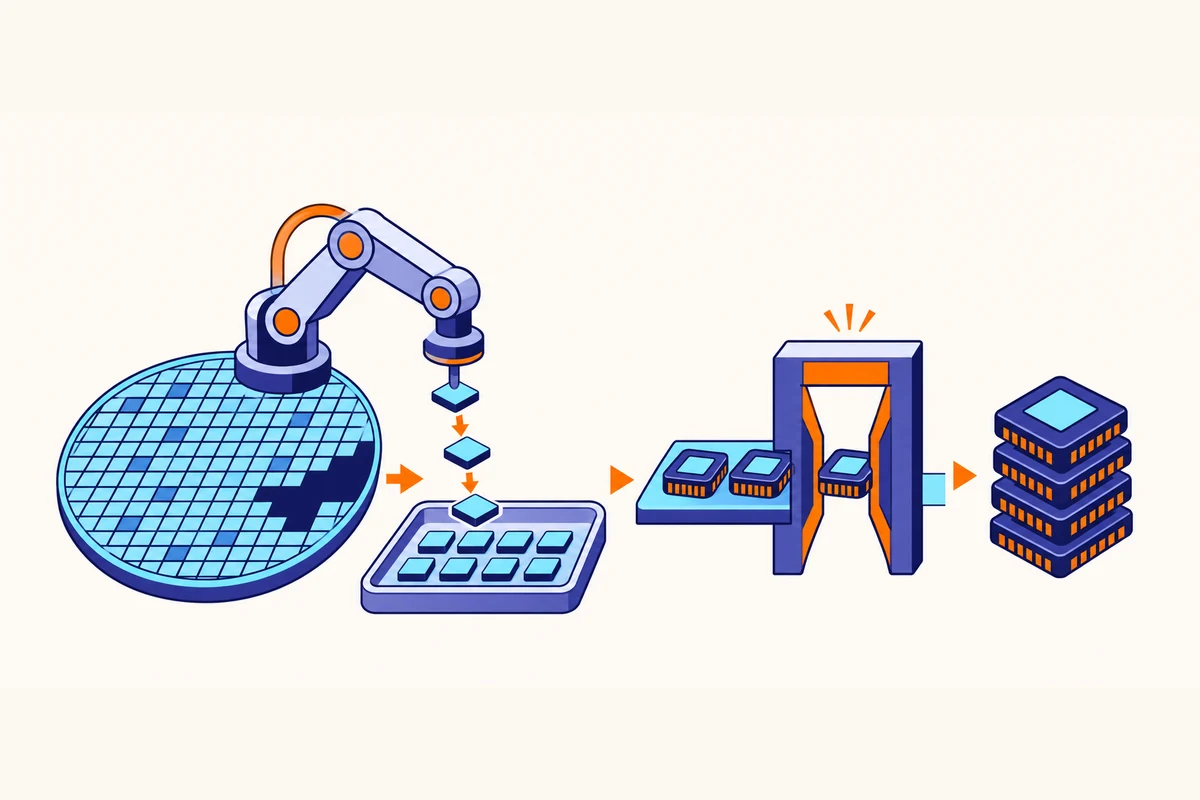
A hypothetical calculation makes the distinction clear. Start with 100 wafers and an estimated 1,000 usable die sites per wafer before electrical tests. At 85 percent electrical yield this produces about 85,000 passing die. If 98 percent pass packaging and final testing, about 83,300 saleable units remain. The numbers illustrate a possible calculation and describe neither company’s performance. The contract has to specify whether a milestone is measured at wafer release, electrical testing or acceptance of packaged parts. A few points of yield make a visible difference once volumes grow.
Packaging may be the constraint even if wafer starts are available. A chosen package needs materials, tooling and a qualified assembly flow. Test capacity has to fit the expected manufacturing volume and product specification. A temperature range or accuracy requirement can lengthen the tests used to qualify a device. The suppliers may be different companies across several places. A turnkey service has a practical advantage when it handles these dependencies and states who resolves a failure instead of leaving the customer to guess which contract needs attention.
Acceptance of one lot does not answer what happens with later lots. A customer may need evidence that the results are consistent as the factory moves from trial batches to production. If one property shifts, the supplier needs to identify the affected lots and communicate what is still within specification. The buyer can then decide whether to accept parts, run an additional test or adjust the delivery schedule. A useful supply agreement establishes how those decisions will be documented and who pays when the work expands. That keeps the relationship between yield and delivered parts observable after the first qualification.
Industrial customers often care about continuing supply years after a launch. Retesting on a different foundry process or moving to a new package can require engineering money, line time and a new acceptance decision. Keeping the same process may also create a dependency if that capacity becomes scarce. Good planning starts with an expected service life, options for inventory and a way to evaluate changes in manufacture. A stable relationship can help arrange those things. Stability is practical when the buyer can see what a supplier is obliged to deliver.
Quantity also interacts with dates. A company can receive enough total parts and still miss its own shipment if they arrive in the wrong months. During ramp-up, a customer may need a small quantity for pilot machines, a larger qualified order for the launch, and a predictable flow once stable. Wafer production and assembly have to line up with this progression. The promise a buyer seeks often includes a schedule and an escalation path, as well as a total number. Those items are usually more useful than a statement that supplier relationships are strong.
A risk team can ask what happens when an initially attractive part moves to a higher-volume change. Ordering more can require new test equipment or extra time at a packaging partner. The manufacturer might face different unit prices at each volume. A channel partner with an existing relationship may have a faster way to communicate new forecasts. It may still have to compete for the relevant factory slots. Investment can create a reason to make the relationship work, while scale ultimately depends on resources and contracts.
The words an actual capacity commitment uses#
GlobalFoundries has used specific language when describing capacity reserved for a particular chain. In 2023, its agreement with General Motors disclosed a dedicated production corridor for GM’s chip supply. GlobalFoundries said it would manufacture for key GM chip suppliers at its facility in upstate New York. Even that announcement left quantities and detailed terms private. It identified an exclusive purpose, a supply chain and a manufacturing location. That is material evidence of a production commitment, distinct from a goal of improving wafer access. GlobalFoundries and GM’s joint announcement
The November Cyient announcement says the investment is expected to improve wafer supply assurance and resilience. It does not name a fab, node, schedule or allocation secured by the transaction. The existing channel materials also do not disclose exclusive capacity. These are ordinary limits of a public deal announcement. They matter when readers try to translate it into output. The claim can reasonably be taken as a statement about what the parties hope to achieve by working together. Specific customer obligations would need a production agreement or later disclosure.
A useful agreement might pin down monthly quantities or a priority mechanism, acceptable variation and when the buyer has to place a firm order. It might specify how long a planned slot remains open and how the consequences of a delay are handled. Buyers can also ask whether the price changes for updates, shortfalls or extra tests. Of course a real purchaser may never publish those clauses. The point for a reader is that the availability of dependable production is evaluated through commitments tied to the manufacturing work itself.
A public announcement can still show progress without exposing a customer’s detailed contract. A producer can say that a process has been selected, a prototype programme reached the prescribed test stage, or its first series lots were accepted. It can also say which stages remain conditional. This is more informative than announcing a maximum production rate with no time window or a design win with no point of delivery. A reader can then ask the next question at the right stage. That is especially useful for a business that works through foundry, assembly and test partners, each of which has its own capacity and schedule.
An access arrangement can still have value without an exclusive reservation. Smaller teams may need help picking among processes, checking tools and getting a cost estimate. An experienced partner can answer questions earlier or get the right contacts involved. Relationships may reduce the time spent correcting assumptions about design rules and lead times. That value appears in fewer rework cycles or a clearer route to prototype and testing. Describing it precisely helps distinguish an operational gain from a promise of priority.
The physical commitment also involves choices for the foundry. Reserved slots cannot be sold freely to another customer. A guarantee can include minimum orders, deposits or multi-year purchasing obligations on the other side. Those commitments protect the operator from paying for idle resources while a programme slips. They can raise the buyer’s risk if demand is uncertain. Both sides may want a shorter prototype arrangement before signing a longer production agreement. That is one reason a channel and a customer order are negotiated separately.
Cyient has to carry the project beyond design#
Cyient describes its semiconductor business as fabless and says it offers design and turnkey services. Its previously completed $85 million majority investment in Kinetic Technologies added a business with power management products and intellectual property. That acquisition shows a separate way of expanding what the business can offer. Buying a design and product portfolio can support more customer projects. Foundry access supports the route by which designs become physical units. The two can reinforce one another when a buyer finishes qualification on a product using the combined capabilities. Cyient’s Kinetic completion announcement
The business model works differently across projects. In some the customer may want Cyient to design a chip and hand over the work before manufacture. In others the customer may buy finished parts from the turnkey provider. That distinction affects who carries stock, funds a respin and has to accommodate changes after qualification. It also affects the revenue and risk associated with volume. A larger project can be attractive when its development work and sale of parts are adequately funded. It can be difficult if a delay leaves an engineering team and reserved capacity waiting.
The connection to India’s semiconductor ambitions is specific. The people designing, validating and qualifying chips can create local capabilities through global manufacturing relationships. The fabrication, packaging and test sites for a device still have to be identified individually. GlobalFoundries’ proposed investment is additional backing for a design and supply business in Hyderabad. The announcements do not describe a new plant in India, specify a local wafer line or transfer foundry ownership. A reader can see what work the Indian company does and what work it buys.
A design partner with foundry relationships can also help customers choose when to maintain a second path. Some components justify a process that can remain available for years. Another device may be cheap to redesign or have enough inventory to handle a short interruption. Maintaining two validated designs or qualifying another vendor can cost more than the risk a customer would avoid. A predictable manufacturing channel is valuable when it gives the customer enough information to decide. Claims about resilience are stronger if they are supported by tested plans for the specific disruptions the buyer considers likely.
The investor’s position invites a procurement question. If a customer’s design needs a different process, it must be clear whether the design team will present that option and what work it can support. A foundry investor may benefit from repeat orders. The customer can have a different goal, including price, continuity and preference for a qualified source. Commercial terms and a technically justified choice can align those interests for a project. Public information about the investment gives a reason to ask about them without suggesting that a private decision has already been made.
The evidence of changed supply will come in stages#
The first measurable follow-up is completion of the subscription and entry into effect of the associated shareholder arrangements. That will establish that the investment moved past approval. The second is a named or otherwise verifiable manufacturing programme. It could disclose the process and scope of the work without revealing the customer’s entire design. Prototype samples and qualification would provide progress evidence. A production award and delivered batches would show how volume and timing have changed.
Cyient can describe results by separating access, trial and supply. Time to sample may improve if planning is clearer. A steady run schedule may matter more to a buyer of mature components. A higher yield may lower unit cost but does not itself show capacity increased. Documentation can explain which development happened and who experienced it. An investor can then tell whether the money improved an existing channel, opened new segments or mostly represented financial backing.
The proposal adds $10 million of planned equity to a channel relationship announced more than a year ago. The amount and valuation are visible. The wafers available to a particular customer will be determined by the work that usually receives less attention, from design verification and fabrication orders through qualification and supply across several years. When buyers can see that a chip moved through those steps and reached volume on the terms promised, the strategic relationship will have a result they can measure.